







- EDITIONS:
 Spanish News Today
 Alicante Today
 Andalucia Today
Spanish News Today Editors Roundup Weekly Bulletin Nov 21

TOP STORIES: "Wetherspoon is opening its first pub in Spain" & "Crackdown on squatters as cutting off utilities to okupas will no longer be a crime"
Hi, sorry for the mix-up with the sending last week. A glitch in our computer system. Let’s try to make up for it this week with a good mix of interesting stories, including Wetherspoon opening their first pub in Spain soon, a change to the law which should help with the eviction of illegal squatters and plenty more besides.
Enjoy!
Spain chosen as destination for first overseas Wetherspoon pub
It’s pretty much a pre-flight ritual these days when you’re at any UK airport. Whatever time it is, whether four in the morning or eleven o’clock at night, it’s obligatory to have a cheeky pint at ’Spoons before boarding.
Soon, you’ll be able to do exactly the same if you’re flying back from Spain… or at least from Alicante Airport, where Wetherspoon (or is it Whetherspoons? Or Weatherspoon’s? Certainly not Weatherspain’s…) will soon be opening its first pub in continental Europe at the end of January 2026.

They’re going to call it ‘Castell de Santa Bàrbera’ – the name in the Valencià language after the castle in Alicante city – and have confirmed that it will be open seven days a week from 6am to 9pm (so not quite a 4 o’clock in the morning jobby, then).
There’s even going to be an outdoor terrace so you can sit out and enjoy the sunshine, and they plan to serve food all day long – a mix of pub standards, Full English breakfasts and Spanish local dishes like garlic prawns and tortilla de patatas.
Of course, there are plenty of other options, and better places to get a tortilla de patatas, but you can bet many punters will appreciate the familiarity and comfort of that classic pub feel. Just as long as it doesn’t get out of hand with people putting back five or six pints before getting on the plane, because we all know how that ends.
In the meantime, Wetherspoon is known to be on the lookout for more expansion opportunities elsewhere in Spain and across Europe. Destinations such as Benidorm and Mallorca have been floated through the grapevine, so keep an eye on this.
Cutting off utilities to squatters in Spain will no longer be a crime

Back in April, Spain made an important update to the law that, in theory, makes getting unwanted squatters out of your property much easier. In a nutshell, if there are clear signs of breaking and entering and the police are called within 48 hours of the home invasion, the unpaying ‘tenants’ can be removed, even if they’re technically classed as ‘vulnerable’.
That all sounds great and should go a long way to fixing the country’s squatting problem, which, far from improving, is only getting worse. However, as always, the devil is in the details, and the law change technically only applies to primary residences. If okupas illegally enter your holiday home, second property or rental, you’re essentially goosed. All the police can do here is document the illegal occupation and start the process for a precautionary eviction order. In short, you’re still going to have to go through the courts.
Last year, almost 15,000 cases of squatting and breaking and entering were reported in Spain, the third highest annual figure ever. Homeowners’ hands are helplessly tied. If they try to forcibly remove the interlopers, they risk being charged with a crime of coercion. If they handle things the lawful way, they face a costly and lengthy legal battle, and all the while the squatters are living rent-free, and often destroying their property.
But how about turning the tables and making it far less attractive to usurp someone else’s home? That’s the plan with the latest revision of the Penal Code, which is being passed through the motions as we speak.
If and when it’s ratified, it will mean it will no longer be a crime to shut off the utilities in a squatted property. The idea is that okupas are far less likely to hang around if they don’t have water, electricity or gas, and that squatters will think twice about illegally entering a house when they know these basic facilities won’t be available to them.
For this groundbreaking legislation to become law, it will first have to be ratified in Congress, but there’s a lot of cross-party support behind it. And if it does come to fruition, it should drastically reduce the shocking number of squatting complaints across Spain.
How to spot a fake V-16 emergency light in Spain

If you’ve got a car in Spain, you’re (hopefully!) already well aware that from January 1 next year, those old warning triangles you’ve probably got shoved in your boot are getting the boot themselves. Every vehicle in the country will need to carry an approved V-16 emergency beacon instead.
If you break down or have an accident, this little device automatically sends your exact location to the authorities in real time. No faffing about with triangles on a dark motorway, no hoping someone spots you in the rain. Emergency services know where you are, other drivers get warned and you stay safe inside your car. It’s genuinely brilliant technology.
But – and this is a big but (oh, grow up!) – the market is already flooded with fake ones. With the January deadline looming, dodgy sellers have jumped on the opportunity. You’ll find approved and non-approved models sitting right next to each other on major online platforms and in shops, often with absolutely no indication of which is which. It’s a minefield out there.
So how do you spot a real one? First things first, check the approval code. It should be an alphanumeric number that starts with either LCOE or IDIADA. This needs to be engraved or printed directly onto the device itself, not stuck on a removable label. If you can peel it off, it’s a fake. Walk away.
Next up, make sure it clearly says it has IoT connectivity and connects to DGT 3.0. That’s the whole point. Without that, you’ve just bought an expensive torch. A proper V-16 has its own integrated SIM card that works for at least 12 years, independently of your phone signal. It’ll work in areas where you’ve got no mobile reception, which could literally save your life.
Price is another giveaway. Genuine approved V-16 beacons run between €40 and €50. The fakes tend to be around €20. If it seems too good to be true, it probably is.
The DGT has an official list of approved models on their website https://www.dgt.es/muevete-con-seguridad/tecnologia-e-innovacion-en-carretera/Dispositivos-de-presenalizacion-V16/. Take five minutes to check the one you’re thinking of buying against that list. Job done.
Don’t forget to join our Driving in Spain Facebook group to keep up to date with all the latest motoring and travel news.
Murcia
Some familiar topics for our Murcia section this week, starting with Corvera Airport. Even though there’s no sign of a Wetherspoon opening there any time soon, passenger numbers have nudged up once again this year, although you wouldn’t exactly call it a boom. Between January and October, 862,835 people passed through the Region of Murcia International Airport, which is a slight 2.2% rise on last year.
It’s going in the right direction but, as ever, if you compare those figures to the days of San Javier Airport, the shine comes off quickly. San Javier’s October 2007 numbers were more than double Corvera’s last month, and in the first ten months of that same year the old airport welcomed 1.8 million passengers. Corvera is sitting at less than half that.
Oh well. The march of progress is slow, and the road to making Murcia more successful is about evolution, not revolution anyway. Plus, would you really want it to turn into a Málaga or an Alicante? Better to keep it a secret, no?
Onto another one of our favourite topics now: the Mar Menor. Researchers from the Institute of Marine Sciences have discovered a hidden mercury source leaking into the lagoon from underground water flows. It seems that this heretofore unknown leak is dumping around a kilo of mercury into the lagoon each year, seventy times more than what enters through the Rambla del Albujón, the source everyone has focused on for years.
What’s worrying is not only the amount, but the conditions this creates along the coastline, making it easier for methylmercury to form. The researchers emphasised that much of this pollution comes from old mining and agricultural activity in the area, which has left deposits in the soil that continue to bleed into the lagoon decades later. Current levels aren’t considered dangerous, but it’s not exactly good for the lagoon, which, with rising temperatures and lower oxygen levels, is more vulnerable than ever.
Over in Camposol, police booted out a couple of squatters last week. The property owner was abroad, which allowed the okupas to get in, but police acted quickly to go and kick them out. The home was subsequently sealed and secured until the grateful owner could return.
 A group of Murcia’s seniors were having a far more cheerful week at Caser Residencial Santo Ángel, where the staff teamed up with the Alzheimer’s Association for a lively workshop aimed at keeping minds active. Residents spent the day playing memory and coordination games, from colour-sorting challenges to a quirky fishing-rod race that had everyone laughing.
The idea behind these gatherings is simple: give people a relaxed space to socialise while also engaging the parts of the brain that help slow cognitive decline. The centre has been building on these kinds of activities to help residents face dementia with as much support and warmth as possible.
Meanwhile in Cartagena, Movember has taken over the Espacio Mediterráneo shopping centre with a campaign designed to bring men’s health out into the open. Under the banner #SácaloALaLuz (‘Bring it out to the light’), the commercial centre is handing out information and advice on preventing and detecting male cancer early.
 To lighten the mood, they’re giving away moustache-shaped lollipops and inviting people to post a photo with them on Instagram for a chance at a prize. Movember itself has come a long way since the days when it was just about growing moustaches, and with more than 1,300 projects funded over two decades, it’s now one of the biggest global voices for men’s health.
CBRE, which manages the centre, is rolling out similar campaigns in dozens of its other properties across Spain and Portugal, hoping to push more men to talk, check and catch things early.
And then, as if Cartagena didn’t already have enough going on this month, the city is also playing host to zombies! Norman Reedus, better known as Daryl Dixon from The Walking Dead, has been filming scenes for the fourth and final season of the spin-off series, ‘The Walking Dead: Daryl Dixon’, which is set to hit TV screens next September.
He has been spotted around the city, enjoying cafés and bars before heading off to shoot at El Portús or the Port of Escombreras. The season follows Daryl and Carol as they trek across post-apocalyptic Spain, trying to make it back to the US.
Cartagena is becoming a regular backdrop for major productions; just recently, Trapería Street was transformed into Budapest for an international thriller. With more than a hundred crew members working on the series and so many local landmarks appearing on screen, the Region is steadily carving out a name for itself in film and television. Not such a secret corner of Spain then?
Now, if you fancy getting into the Christmas mood early this year, you can go and see the lights being turned on in Murcia city this Saturday, starting at 7pm. If not, there’s a free guided tour in English of El Berro, the gateway to the Sierra Espuña natural park, also on Saturday, or, coming up on Thursday November 27, a free screening of Charlie Chaplin’s ‘City Lights’ in its original version in Cartagena.
See our EVENTS DIARY for more events and activities coming up soon in the Region of Murcia:
Spain
If you smoke, chances are you’ve already noticed. This week, tobacconists across Spain have put the prices up on 77 different tobacco products. Cigarettes, cigars, cigarillos, pipe tobacco, the lot. The Ministry of Finance published the details on November 14 and the new prices have already come into effect.
For those brands affected, the increases hit Adrian Magnus, Barreda, Montego, Mark 1, Hampton, Kendal, North Star, Rodeo, Samuel Gawith and Sebero pipe tobacco in various forms and sizes.
Not only has smoking become very unfashionable, it’s flipping expensive as well!
Cast your mind back to 1990. You could get a pack of cigarettes for the equivalent of about 65 cents. Fast forward to the early 2000s and you're looking at around €2.50. By 2015, the average price had climbed to roughly €4.45. Now here we are in 2025, and most cigarettes are priced somewhere between €5 and €7 a pack.
But you know what? It seems to be working. Tobacco consumption in Spain has hit the lowest percentage in living memory. Back in 1997, nearly 47% of Spaniards reported having smoked in the previous year. By 2024, that figure had dropped to just under 37%.
That’s a significant drop, even if it does mean more than a third of the population is still lighting up.
Autumn in Spain is just gorgeous, isn’t it? All those golden leaves, the crisp air and cool weather to enjoy long, leisurely strolls. It’s the perfect time to get out and about with the dogs, but you need to be aware that this time of year brings a genuine risk to your furry friend.
Cases of dogs needing surgery to remove acorns stuck in their intestines aren’t rare and it’s not just a problem over in the UK. Here in Spain, vets are actively warning pet owners that several varieties of acorn commonly found scattered on paths, in parks and in scrublands can be seriously dangerous for dogs. Some puppies have even needed life-saving surgery after swallowing them.

Acorns contain tannins, which are bitter substances plants produce as a natural defence mechanism, and they’re poisonous when ingested.
Just five to ten acorns are enough to poison a dog weighing around 10 kilos. That’s not a huge amount, which means the risk is real and present during autumn walks.
The toxicity itself is one problem, but the physical danger is often the bigger issue. Acorns can get lodged in a dog’s intestines, causing what’s called ‘ileus’ or intestinal obstruction. This is a potentially life-threatening condition that needs immediate vet attention.
If you spot warning signs like persistent vomiting lasting more than six hours, abdominal pain, fainting or obvious panic in your dog, get to the vet straight away. These could indicate an obstruction.
When a dog has eaten enough acorns to cause poisoning, you might notice general weakness, loss of appetite, increased thirst, excessive drooling or nausea. In severe cases, the tannins can damage the liver and kidneys, causing jaundice, which shows up as yellowing of the mucous membranes and eyes.
Over the last couple of years, train travel throughout Spain has become a lot more affordable. With increased competition from the likes of Ouigo and Iryo, state rail operator Renfe has been forced to drastically reduce its prices. Great news for passengers.
However, determined to get their money one way or another, last year Renfe changed its compensation policy so they’d only have to pay out for delays exceeding an hour. So there was plenty to celebrate when, earlier this week, Spain passed a law forcing the train company to revert to its previous policy.
 This means that you’ll be entitled to 50% refunds for delays of 15 minutes or more, and 100% refunds if the delay stretches beyond 30 minutes. For high-speed and long-distance services, that’s a return to how things worked before July 2024.
But here’s where things get interesting. While the policy backtrack had widespread support from the PP, Vox, Junts, ERC and PNV parties, PSOE Transport Minister Óscar Puente isn’t a bit happy. His department is gearing up for a legal fight, claiming that the new law is “unconstitutional” as it violates Spain’s principles of free competition.
His fear is that the stricter compensation rules will put Renfe at a serious disadvantage compared to its private rivals Ouigo and Iryo, which only offer compensation for delays of 60 minutes or more.
The Ministry reckons the new compensation policy will cost Renfe an extra €43 euros every year, money the company would need to recoup somehow, which could mean hiking ticket prices and making it harder for the operator to compete with those private companies.
Puente and the Ministry of Transport are actively exploring legal avenues to get around the new requirements, hoping to find loopholes that would let Renfe stick with the current, more lenient compensation system.
Alicante
Checking into a hotel, booking a holiday apartment or even hiring a rental car has become a bit of a nightmare in Alicante thanks to new Spain-wide regulations that mean hotels, travel agents and car firms now have to collect dozens of personal details from every single customer.
It sounds reasonable enough in theory, but in practice some medium-sized hotels are now spending up to 10 hours a day just processing registrations. Long queues, frustrated staff, frustrated guests. It’s a bit of a mess, to be honest.
But there might finally be light at the end of the tunnel. A new technology called the European Digital Identity Wallet has just completed its first successful trial, and if it works as promised, it could completely transform the whole tedious process.
The pilot test happened at the Michelangelo Hotel in Benidorm, where Fabián Torres, business development director at SICPA, put the system through its paces. The experience was remarkably straightforward. The day before his trip, he downloaded the digital wallet app to his phone and uploaded his documents. When he arrived at the hotel, he pointed his phone at a QR code linked to his reservation and that was it. The entire check-in took about 10 seconds instead of the usual 10 minutes.
The data transferred instantly to the hotel’s system, ready to be passed on to the police as required by those new regulations. No need for reception staff to sit there manually typing in page after page of information, which means fewer errors and a massive time saving.
Just as importantly, the information went straight to the authorities without anyone at the front desk seeing it, keeping personal data completely confidential throughout.
The trial clearly went well, but don't expect to be using this thing anytime soon. The wallet will become available to everyone in December 2026, with the full rollout across the entire European Union starting in January 2027. That’s still more than a year away, which means you’ll have to put up with the current check-in chaos for a bit longer.
To the property market now, as Alicante has become the undisputed favourite for foreign home buyers. In the second quarter of this year alone, foreigners bought twice as many properties in Alicante as they did in Málaga, which is genuinely remarkable given the Costa del Sol’s long-standing reputation as Spain’s go-to destination for overseas purchasers, particularly the British.
When you look at the wider picture across Spain, the appetite for property is clearly strong. During the third quarter, 174,384 home sales were registered, which represents a 4.7% jump compared to the same period last year. Foreign nationals were responsible for almost 23,700 of those transactions, with roughly 9,100 being second homes.
What’s particularly striking is that just two provinces, Alicante and Málaga together, account for more than a third of all property sales by non-nationals, hitting 35.9% between them.
The Costa Blanca’s dominance is really something else. Alicante racked up 5,741 international transactions, representing 43.29% of all provincial sales. To put that in perspective, that’s more than double what the Costa del Sol managed with 2,750 foreign purchases. Málaga’s still doing very well by most standards, mind you, but the gap between first and second place here is substantial.
As for who’s actually doing all this buying, the British remain at the top of the list, accounting for 7.9% of all property sales in Spain. Nearly 2,000 British purchases happened this year, which is a solid showing.
Germans are close behind with more than 1,500 transactions, but the really interesting development is the Dutch. Buyers from the Netherlands have ramped up their purchases by almost 14% year-on-year, making them the standout performers this time around.
And lastly, the Trinity Bar in Cabo Roig is once again throwing open its doors to local crafters for a series of free Christmas markets running every Thursday until mid-December.

The festive craft fair will take place on the bar’s sunny terrace on four consecutive Thursdays, starting on the November 27 and continuing on the 4th, 11th and 18th of December. Each market runs from 9am until 2pm, perfectly timed to catch the crowds from the regular Thursday market happening right on its doorstep.
Organisers are calling for anyone with handmade ornaments, scarves, gifts or other crafted goods to sign up for a stall. The whole thing is completely free for sellers, with no fees or charges attached. The bar is simply offering the space and the opportunity for crafters to showcase their work in a spot that's guaranteed to see plenty of passing trade during one of the busiest times of the year.
Stall spaces are limited so anyone interested needs to get in touch sooner rather than later. Crafters can reserve their spot by popping into The Trinity Bar directly or sending a message on their Facebook page.
For other events and activities happening in the area, check out the What’s On page of Alicante Today or join the Costa Blanca What’s On and Where to Go Facebook group
Andalucía
In Andalucía, this week began with a grim discovery in Benalmádena, where the lifeless body of a 57-year-old man was found floating at dock 3 of Puerto Marina.
Emergency services swiftly responded to the call just before 9am on Sunday November1 6, involving multiple agencies including the Guardia Civil and Maritime Rescue.
While the man’s identity is known, details surrounding his death remain under investigation. Authorities are considering whether recent severe weather conditions from Storm Claudia played a role, though no further information has been released yet.
Shifting slightly along the coast to Fuengirola, a violent assault that occurred in late September has resulted in the death of a 63-year-old Finnish man. The incident unfolded near the marina taxi queue after a dispute involving two women trying to cut in line.
 A 25-year-old Norwegian alleged to have punched the Finnish victim was arrested recently and is now being held on murder charges after the victim succumbed to his injuries almost two weeks later in October.
On a different note, Málaga city’s skyline is set for a bold transformation with the planned construction of a towering new hotel on the Levante dock.
Designed by renowned British architect Sir David Chipperfield, the 144-metre Port Tower will feature nearly 400 rooms, rooftop gardens, and an expansive, pedestrian- and cyclist-friendly promenade stretching 1,300 metres along the harbour.
Supported by major investment groups including the Qatari fund Al Alfia and Hoteles Hesperia, this sustainable project aims to blend sleek modern design with generous green spaces for public use, adding around 54,000 square metres of new civic areas.
Developers say it will connect the city and the sea in a fresh way, creating jobs and offering a convention centre for 2,000 guests. Jordi Ferrer, the Chief Executive Officer (CEO) of Hoteles Hesperia said, “It’s a long and rigorous project that adds real value to Málaga.”
However, the project has sparked lively debate. Some locals worry the skyscraper clashes with Málaga’s historic charm and fear it could push the city towards a more homogenised, mass tourism model reminiscent of Benidorm. Residents and opposition parties have even called for a public referendum on the tower’s future, reflecting wider questions about Málaga’s identity and who gets to shape its skyline.
Despite this, developers remain confident that the meticulous plan, currently under final review at the national level, will receive approval to start construction soon. If all goes to plan, the hotel could be operational by 2029, promising to be a defining feature of Málaga’s waterfront for decades to come.
And finally this week, Cádiz took a big step forward in disaster readiness when it staged Response25, Spain’s largest-ever tsunami drill, on Thursday November 20.
Over 20,000 people participated in the drill, including 1,000 emergency workers along with local residents, schools, businesses and public services, all practising how to evacuate safely following simulated alerts for a tsunami.
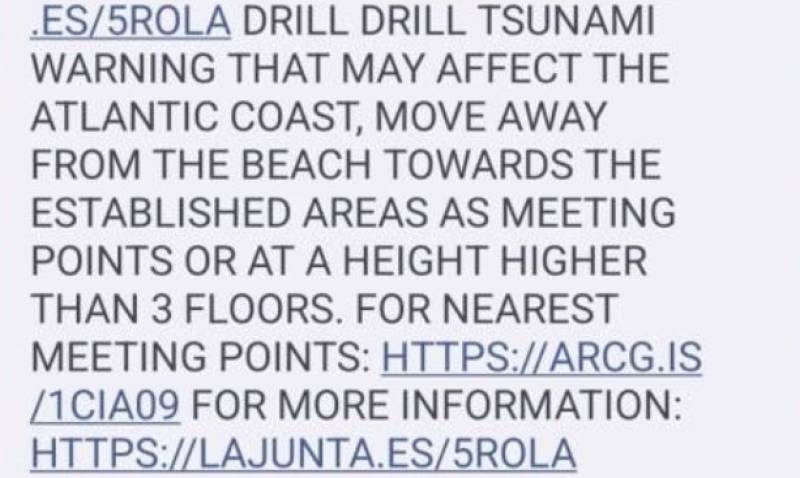
At 10.15am, sirens sounded and ES-Alert messages buzzed across phones citywide, including a special alert system for the hearing impaired. The message on the phones read, first in Spanish and then in English:
“Drill drill tsunami warning that may affect the Atlantic coast, move away from the beach towards the established areas as meeting points or at a height higher than 3 floors.”
This alert was repeated five minutes later to ensure everyone was reminded that it was a drill and no action was actually needed. It was the first time this new, multi-language and accessible warning system was used, marking a major step forward in emergency communication for coastal safety.
The drill was impressively comprehensive. Evacuations from schools, hotels, senior residences and offices were carried out alongside simulated sea rescues for surfers at Santa María del Mar beach. They even tested vertical evacuations to upper floors in flood-prone areas.
Emergency teams, police, fire, health and local authorities all worked seamlessly to coordinate their efforts. Detailed flood risk maps helped responders and residents identify safe locations quickly, with special care taken to protect Cádiz’s historic sites.
Andalucía’s Minister of the Presidency, Antonio Sanz, said: “With Response25, we prepare for the worst but hope we never face it. It’s about planning, coordination and collective effort to keep Cádiz safe.”
You may have missed…
- New train station will let Andalucía bypass Madrid on the way to Barcelona.
Passengers travelling between Andalucía and Catalonia could soon skip Madrid altogether thanks to plans for a new high-speed railway station in Parla that will allow trains to bypass the capital's congested Atocha and Chamartín terminals. - Getting vaccinated against the flu or Covid reduces the risk of stroke and heart attack.
According to the Spanish Association of Vaccinology (AEV), flu and Covid-19 jabs have benefits beyond preventing the diseases for which they were designed, as the flu vaccine also reduces the risk of stroke and heart attack, while coronavirus injections decrease thromboembolic complications. - Taste of Spain: 5 foodie destinations you can reach direct from the UK.
When you think of Spanish food, paella, chorizo or tortilla probably spring to mind – and they’re delicious, of course. But Spanish cuisine is much more diverse and comes alive in winter across different regions. - Why Murcia farmers are turning to pistachios as their new wonder crop.
These days, pistachios seem to be everywhere, from fancy restaurant menus and pastry shops to supermarket shelves stacked with bags of them. In the Region of Murcia, farmers have definitely noticed this trend and they’re jumping on the bandwagon. - Discover Spain's largest natural labyrinth in Murcia – and it's free to explore!
Looking for a fun and unique day out? Explore Spain’s largest natural labyrinth made of two-metre-tall Leyland cypress trees, nestled in Cartagena’s Rafael de la Cerda Leisure Park in Tentegorra: a green maze full of twists, turns, and surprises waiting to be discovered.
There we go, that should do it for this week. Thanks for reading once again, and see you for more next week.
Bye!